วันอังคารที่ 21 กุมภาพันธ์ พ.ศ. 2555

Foie gras


     Le foie gras est une spécialité culinaire à base de foie frais issu de l'élevage puis de l'engraissement par gavage d’oies et de canards. Le foie gras frais est le produit agricole issu de l'élevage avicole et le foie gras cuit correspond à la spécialité culinaire.

Histoire


     Représentée dans les fresques de tombes vieilles de 4 500 ans à Saqqarah, la pratique du gavage des oies remonte au moins à l'Égypte ancienne. Les Égyptiens gavaient plusieurs espèces d'oiseaux palmipèdes, dont des oies, à l'aide de granules de grains rôtis et humidifiés.
     La pratique s'est poursuivie sous l'Empire romain. Pline l'Ancien évoque le gavage d'oies à l'aide de figues séchées. Au IVe siècle, le De re coquinaria d’Apicius donne sa première recette. 
     Le foie produit s'appelait en latin Jecur ficatum, que l'on traduit littéralement par « foie aux figues ». Les anciens ne conservèrent que le terme ficatum ou figue pour sa dénomination, ce qui donna la forme figido au VIIIe siècle, puis fedie, feie au XIIe et finalement « foie ». Cette racine se retrouve dans les langues romanes, comme le français, l'italien, le portugais, l'espagnol et le roumain.
     La tradition du foie gras s'est perpétuée après la chute de l'Empire romain en Europe centrale, dans les communautés israélites. Les juifs utilisaient fréquemment la graisse d'oie pour la cuisson, car le beurre avec la viande et le saindoux leur étaient interdits. De plus, les huiles d'olive et de sésame étaient difficiles à obtenir en Europe centrale et de l'ouest. Les israélites répandirent l’élevage des oies, de l’Alsa  ce jusqu’à l’Oural, et apprirent à en maîtriser le gavage, surtout dans les régions où l'on cultive le maïs (qui fut introduit au XVIIe siècle) : l’Alsace et la Hongrie.
     Ainsi, si traditionnellement deux régions de France, l'Alsace et le Sud-ouest, se disputent la paternité de ce mets de fête, l'origine du foie gras est en réalité très ancienne: il est toutefois définit dans la loi française comme faisant partie du patrimoine culturel et gastronomique du pays.

Consommation

Côté cuisine, le foie gras peut être préparé de différentes manières:
  • Cru : produit de base de travail des cuisiniers, le foie gras cru permet tous les mariages et mise en valeurs possible du produit, c'est dans cette présentation qu'il peut être préparé avant mise en conserve ou service, il ne se garde pas longtemps. On le trouve sur de nombreux "marchés au gras" du sud de la France, ainsi que chez les producteurs de foie gras d'oie et de canard.
  • Mi cuit : le foie gras mi cuit a été pasteurisé à moins de 100° par une cuisso n à cœur et est généralement présenté dans des terrines ou bocaux. Le foie gras mi cuit se conserve plusieurs mois au réfrigérateur, est onctueux et conserve tous les arômes du foie fraichement travaillé.
  • Cuit : également appelé foie gras traditionnel, il est stérilisé en autoclave à plus de 100°C. C'est la forme la plus traditionnelle de vente que nous connaissons, à l'instar des grands crus il peut être conservé dans un endroit frais et sec pendant plusieurs années, pendant lesquelles il se bonifiera.
     La France est également que le premier consommateur de ce produit, avec 19 000t annuellement. On le consomme traditionnellement froid en entrée, le plus souvent lors de repas de fête (réveillons de Noël et de la Saint-Sylvestre par exemple). Il est également possible de le consommer chaud, seul (escalope de foie gras poêlée) ou comme ingrédient d'une recette plus élaborée (notamment dans un tournedos Rossini).
Le foie gras est accompagné le plus souvent d'un vin liquoreux, tels le Sauternes ou le Monbazillac.

White horses

     White horses are born white and stay white throughout their life. White horses may have brown, blue, or hazel eyes. "True white" horses, especially those that carry one of the dominant white (W) genes, are rare. Most horses that are commonly referred to as "white" are actually "gray" horses whose hair coats are completely white.


True white horses


     White horses have unpigmented skin and a white hair coat. They are born white and remain this way throughout life. Many white horses have dark eyes, though some have blue eyes. Some white horses are born with partial pigmentation in their skin and hair, which may or may not be retained as they mature. White coloring, whether white markings, white patterns or dominant white is collectively known as depigmentation phenotypes, and all are caused by areas of skin that lack pigment cells (melanocytes). Depigmentation phenotypes have various genetic causes, and  those that have been studied usually map to the EDNRB and KIT genes. However, much of the genetics behind various all-white depigmentation phenotypes is still unknown.

 Dominant white

     Dominant white is best known for producing pink-skinned all-white  horses with brown eyes, though some dominant white horses have residual pigment along the topline. Dominant white is, as the name implies, a genetically dominant color. At least one parent must be dominant white and it does not "skip" generations because it is not recessive. Nonetheless, new variations or mutations producing dominant white do occur spontaneously from time to time.       
      Dominant white is rare, but has occurred in many breeds. It has been studied in Thoroughbreds, Arabian horses, the American White horse and the Camarillo White horse. There are 11 identified variants of dominant white, each corresponding to a spontaneously-white foundation animal and a mutation on the KIT gene. No horse has been identified as homozygous dominant white, and researchers have suggested that at least some forms of dominant white results in nonviable embryos in the homozygous state. 
     While homologous mutations in mice are often linked to anemia and sterility, no such effects have been observed  in dominant white horses. Dominant white horses typically have white noses that can be subject to sunburn.

Sabino-white

     Sabino-white horses are pink-skinned with all-white or nearly-white coats and dark eyes. They are homozygous for the dominant SB1 allele at the Sabino 1 locus, which has been mapped to KIT. Without a DNA test, Sabino-white horses are indistinguishable from dominant white horses.
      The Sabino1 allele, and the associated spotting pattern, is found in Miniature horses, American Quarter Horses, American Paint Horses, Tennessee Walkers, Missouri Fox Trotters, Mustangs, Shetland Ponies, and Aztecas.Sabino 1 has not been found in the Arabian horse, Clydesdale,Thoroughbred, Standardbred horse, or Shire horse. The Sabino 1 allele is not linked to any health defects, though sabino-whites may need some protection from sunburn. Horses with only one copy of the Sabino1 gene usually have dramatic spotting, including two or more white legs, often with white running up the front of the leg, extensive white on the face, spotting on the midsection, and jagged or roaned margins to the pattern.

White born leopards

     The leopard complex, related to the Leopard (LP) gene, characterizes the Appaloosa and Knabstrupper breeds with their spotted coats. Leopard is genetically quite distinct from all other white and white-spotting patterns. The fewspot leopard pattern, however, can resemble white. 
     Two factors influence the eventual appearance of a leopard complex coat: whether one copy (heterozygous LP/lp) or two copies (homozygous LP/LP) Leopard alleles are present, and the degree of dense white patterning present at birth. If a foal is homozygous for the LP allele and has extensive dense white patterning, they will appear nearly white at birth, and may continue to lighten with age. In other parts of the world, these horses are called "white born." 
     "White born" foals are less common among Appaloosa horses than Knabstruppers or Norikers, as the extensive dense white patterning is favored for producing dramatic full leopards. 
     Homozygous leopards have the LP/LP genotype, and may be varnish roan, fewspot leopard, or snowcap patterned. Homozygous leopards are substantially more prone to congenital stationary night blindness. Congenital Stationary Night Blindness is present at birth and is characterized by impaired vision in dark conditions.

Lethal white syndrome
     Lethal white syndrome is a genetic disorder linked to the Frame overo (O) gene and most closely studied in the American Paint Horse. Affected foals are carried to term and at birth appear normal, though they have pink-skinned all-white or nearly-white coats and blue eyes. However, the colon of these foals cannot function due to the absence of nerve cells, and the condition cannot be treated. 
     Foals with Lethal White Syndrome invariably die of colic within 72 hours, and are usually humanely euthanized. Carriers of the gene, who are healthy and normal, can be identified by a DNA test. While carriers often exhibit the "frame overo" pattern, this is not a dispositive trait and testing is necessary, as the pattern can appear in a minimal form as normal white markings or be masked by other white spotting genes.

Famous White Horses
     Many famous horses, past and present, were alleged to be "white" by observers, but were actually grays with hair coats turned fully white. Likewise, most white horses used in movies are actually grays, in part because they are easier to find.
     However, there are a few truly white horses who were used in film. One of the best-known examples was "Silver," ridden by the Lone Ranger, a role actually played by two different white horses. At least one horse who played "Topper," ridden by Hopalong Cassidy, was also white.    
     Another famous white horse is Yukichan, a Japanese Thoroughbred racehorse who won the Kanto Oaks at Kawasaki Racecourse.

วันอังคารที่ 31 มกราคม พ.ศ. 2555

อิน-จัน

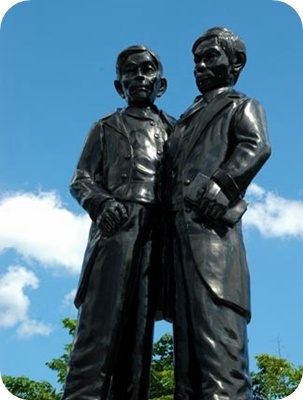
                                              อิน (พี่-ซ้ายมือ) จัน (น้อง-ขวามือ)

     อิน-จัน (11 พฤษภาคม พ.ศ. 235417 มกราคม พ.ศ. 2417) เป็นชื่อของฝาแฝดสยาม ที่มีชื่อเสียงไปทั่วโลก โดยเป็นที่มาของคำว่า "แฝดสยาม" เนื่องจากเกิดที่ประเทศสยาม (ประเทศไทย) ฝาแฝดที่มีหน้าอกติดกันและใช้ตับร่วมกัน คู่แรกของโลกที่สามารถดำรงชีพเหมือนคนธรรมดาได้ตลอดชีวิต
      อิน-จันได้สัญชาติอเมริกันเมื่อปี พ.ศ. 2382 และใช้นามสกุลว่า บังเกอร์ (Bunker) มีลูกหลานสืบตระกูลมาจนถึงทุกวันนี้ ชื่อเสียงของอิน-จัน ทำให้เกิดคำเรียกแฝดตัวติดกันว่า แฝดสยาม (Siamese twins) ตามชื่อเรียกประเทศไทยในเวลานั้นฝาแฝดอิน-จัน เป็นฝาแฝดที่มีตัวติดกันทางส่วนหน้าอก (บันทึกของชาวตะวันตกบอกว่า เนื้อที่เชื่อมกันระหว่างอกนี้สามารถยืดได้จนทั้งคู่สามารถหันหลังชนกันได้)


ประวัติ

     ฝาแฝดอิน-จัน เกิดเมื่อวันที่ 11 พฤษภาคม พ.ศ. 2354 ตรงกับรัชสมัยรัชกาลที่ 2 ในครอบครัวคนไทยเชื้อสายจีน ที่จังหวัดสมุทรสงคราม โดยมีบิดาเป็นชาวจีนอพยพแต่ครั้งรัชกาลที่ 1 ชื่อ นายที มารดาเป็นคนไทยชื่อ นางนาก (บันทึกของชาวตะวันตกเรียกว่า นก (Nok)) ซึ่งฝาแฝดคู่นี้สามารถเติบโตและใช้ชีวิตได้เหมือนคนปกติ แตกต่างไปจากแฝดติดกันคู่อื่น ๆ ที่มักเสียชีวิตหลังคลอดได้ไม่นาน ตามกฎหมายในเวลานั้น ทั้งคู่ต้องถูกประหารชีวิตเนื่องจากความเชื่อที่ว่าเป็นตัวกาลกิณี แต่เมื่อเวลาผ่านไปก็หาได้มีเหตุการณ์ใด ๆ ตามความเชื่อไม่ โทษนั้นจึงได้รับการยกเลิก เมื่อทั้งคู่อายุได้แค่ 2 ขวบ บิดาก็เสียชีวิตลงด้วยอหิวาตกโรค ภาระจึงตกอยู่ที่มารดาแต่เพียงผู้เดียว แฝดทั้งคู่จึงช่วยเหลือมารดาเท่าที่เด็กในวัยเดียวกันจะทำได้ เช่น จับปลา ขายน้ำมันมะพร้าว และทำไข่เค็มขาย จนในปี พ.ศ. 2367 ความพิเศษของเด็กทั้งคู่ทราบไปถึงพระกรรณของพระบาทสมเด็จพระนั่งเกล้าเจ้าอยู่หัว จึงพระราชทานพระบรมราชวโรกาสให้นางนากและอิน-จันเข้าเฝ้าทูลละอองธุลีพระบาท แล้วในปี พ.ศ. 2370 ก็มีพระบรมราชานุญาตให้อิน-จันได้เดินทางร่วมไปกับคณะทูตเพื่อเจริญสัมพันธไมตรีกับประเทศโคชินไชน่า (เวียดนามในปัจจุบัน)
ในปี พ.ศ. 2367 นายโรเบิร์ต ฮันเตอร์ พ่อค้าชาวอังกฤษ หรือที่คนไทยสมัยนั้นเรียกว่า "นายหันแตร" ได้นั่งเรือผ่านแม่น้ำแม่กลอง และได้พบแฝดคู่นี้กำลังว่ายน้ำเล่นอยู่ ด้วยความประหลาดและน่าสนใจ นายฮันเตอร์จึงคิดที่จะนำฝาแฝดคู่นี้ไปแสดงโชว์ตัวที่สหรัฐอเมริกา จึงเข้าทำความสนิทสนมกับครอบครัวของฝาแฝดอยู่นานนับปี จนพ่อแม่ของทั้งคู่ไว้วางใจ ในที่สุดนายอาเบล คอฟฟิน กัปตันเรือสินค้า เดอะ ชาเคม (The Sachem) ซึ่งขณะนั้นได้เข้ามาทำการค้าในประเทศไทย ก็เป็นผู้นำตัวคู่แฝดออกเดินทางจากประเทศไทยเมื่อวันที่ 1 เมษายน พ.ศ. 2372 ขณะนั้นอิน-จัน อายุได้ 18 ปี โดยใช้เวลาเดินทางทั้งหมด 138 วัน จึงถึงเมืองบอสตัน รัฐแมสซาชูเซตส์ และที่นี่เองที่คู่แฝดได้ทำการเปิดตัว ก่อนจะออกเดินทางแสดงทั่วอเมริกาและยุโรปอีกร่วม 10 ปี (เอกสารบางฉบับบอกว่า ไม่ได้เริ่มที่บอสตัน แต่ไปตั้งหลักที่รัฐแคลิฟอร์เนีย) โดยสัญญาที่ทำไว้กับนายฮันเตอร์และนายคอฟฟินสิ้นสุดลงเมื่อทั้งคู่มีอายุครบ 20 ปีบริบูรณ์ โดยในช่วง 2 ปีแรก ทั้งคู่ก็ได้รับส่วนแบ่งค่าตอบแทน แต่ก็มีบางครั้งก็ถูกเอาเปรียบด้วย เมื่อเป็นอิสระทั้งคู่ก็เปิดการแสดงเอง และได้แสดงไปทั่วสหรัฐอเมริกาจนเมื่ออายุได้ 28 ปี ใน พ.ศ. 2382 ทั้งคู่ก็ได้ลงหลักปักฐานที่หมู่บ้านแทรปฮิลล์ (Traphill) เขตชานเมืองวิลส์โบโร (Wilkesboro) เคาน์ตีวิลส์ ในรัฐนอร์ทแคโรไลนา พร้อมกับได้เปลี่ยนชื่อและเปลี่ยนสัญชาติเป็นอเมริกัน โดยมีชื่อว่า เอ็ง-ชาง บังเกอร์ (Eng and Chang Bunker) พร้อมกับได้แต่งงานกับหญิงชาวอเมริกัน และมีลูกด้วยกันหลายคน ซึ่งระหว่างที่ทั้งคู่ใช้ชีวิตในต่างประเทศนั้น มีความพยายามหลายครั้งจากหลายบุคคลที่จะทำการผ่าตัดแยกร่างทั้งคู่ออกจากกัน แต่ท้ายที่สุดก็มิได้มีการดำเนินการจริง ๆจากบันทึกที่ได้บันทึกไว้ ระบุว่า จัน (คนน้อง) เป็นคนที่มีอารมณ์ร้อน หุนหันพลันแล่น และชอบดื่มสุราจนเมามาย ขณะที่ อิน (ผู้พี่) กลับมีนิสัยตรงกันข้าม คือ ใจเย็น สุขุมกว่า และไม่ทานเหล้า อีกทั้งทั้งคู่เคยทะเลาะวิวาทจนถึงขั้นชกต่อยกันเองมาแล้วด้วยจากการที่จันผู้น้องนิยมดื่มเหล้าจนเมามายบ่อย ๆ ทำให้เป็นโรคหลายโรค จนในวันที่ 17 มกราคม พ.ศ. 2417 จันก็เสียชีวิตลงด้วยอาการหัวใจวาย จากนั้นอีกราว 2 ชั่วโมงถัดมา อินก็ได้เสียชีวิตตามไ
ปด้วย ซึ่งจากการชันสูตรและลงความเห็นของแพทย์สมัยใหม่ ระบุว่า อินต้องสูญเสียเม็ดเลือดแดงให้แก่จันที่เสียชีวิตไปแล้ว ผ่านทางเนื้อที่เชื่อมกันที่อก ทั้งคู่เสียชีวิตขณะที่มีอายุได้ 63 ปี


อนุสรณ์

  ส่วนตับที่เชื่อมติดกันได้มีการเก็บรักษาไว้ที่พิพิธภัณฑ์ Mütter ในเมืองฟิลาเดลเฟีย รัฐเพนซิลเวเนีย ส่วนของใช้ส่วนตัวของทั้งคู่ได้ถูกเก็บรักษาไว้ที่ห้องสมุดของมหาวิทยาลัยนอร์ทแคโรไลนา  ภายหลังได้มีการสร้าง อนุสรณ์สถานแฝดสยามอิน-จัน ที่ ตำบลลาดใหญ่ เพื่อเป็นอนุสรณ์สถานแด่ฝาแฝดสยามอิน-จันที่ได้สร้างชื่อเสียงให้กับประเทศไทยไปทั่วโลก


สารคดี

     ในปี พ.ศ. 2534 บริษัทกันตนาได้จัดทำรายการสารคดีของอิน-จัน ขึ้น ในชื่อ "แฝดสยาม" (Siamese twins) จำนวน 26 ตอน ออกอากาศครั้งแรกทางช่อง 7 สี ทุกวันพฤหัสบดี เวลา 18.30-19.00 น. โดยมี ประดิษฐ์ กัลย์จาฤก เป็นพิธีกร รศ.ธงทอง จันทรางศุ, นัฏฐา ลอยด์ และ ดวงดาว จารุจินดา เป็นผู้ค้นหาร่องรอย โดยสารคดีชุดนี้เป็นภาพยนตร์ชีวประวัติของทั้งคู่ ตั้งแต่เด็กจนถึงเสียชีวิตที่สหรัฐอเมริกา ซึ่งผู้ที่รับบทอิน-จัน นี้เป็นฝาแฝดที่มีอาชีพมัคคุเทศก์ จึงไม่มีปัญหาในการท่องบทภาษาอังกฤษ และในปี พ.ศ. 2553 ได้มีการนำสารคดีชุดนี้มาฉายอีกครั้ง ทาง มิราเคิล ในเครือ ไลฟ์ ทีวี

วันพุธที่ 11 มกราคม พ.ศ. 2555

The smallest dog in the world

     The smallest dog ever recorded was a Yorkshire Terrier named Sylvia. She was owned by Arthur Marples from Blackburn, England. Sylvia was 2.5 inches tall, 3.5 inches long from her nose to the tip of her tail, and weighed just 4 ounces. She died when she was just two years old in 1945.

     From 1995 through 2002 the Guinness World Records had Big Boss, a Yorkshire Terrier, listed as the smallest dog in the world. Big Boss was 4.7 inches tall, He was owned by Dr. Chai Khanchanakom of Thailand.

     Before 1995 the smallest dog alive was listed as a Yorkshire Terrier named Thumbelina who stood 5.5 inches tall and who was 8 inches long.

     Another contender for smallest dog in the world is Elwood, the Jack Russell Terrier. Jack Russells are usually a larger breed but tiny Elwood is only 3.5 inches tall, 6 inches long, and weighs 15 ounces. Elwood was over a year old when these measurements were taken so he was no longer a puppy.

     A Chihuahua named Brandy is the current Guinness World Record holder as the world’s smallest dog but her claim to the title has been called into question with the story of Grace, the Pug. http://www.thesun.co.uk/sol/homepage/news/3862597/Is-pooch-worlds-smallest-dog.html

     Grace, the Pug, is less than 6 inches tall and only 6 inches long. She weighs one pound and six ounces, which is four ounces less than Brandy the Chihuahua. However, Grace is only five months old, so she may still be growing. Vets believe that Grace may suffer from a form of dwarfism so she will never be full-size. A Pug normally weighs up to 18 pounds. Grace and her owner, Sandra Devall, live in Great Yarmouth, Norfolk, England.

Concerns

     Dogs that are exceptionally small often have additional health problems and they may have a shortened lifespan. Some breeders may try to breed Toy dogs to make them smaller but there are risks to the puppies. It is also not easy for smaller Toy breed mothers to breed naturally or to produce puppies. Breeders usually charge much more for these very small puppies. Some of these very tiny dogs may be substandard and they may not meet the breed club’s standard of what a good dog should be like.


      Boo Boo is a breed of Chihuahua with a height of 10.16 cm and Boo Boo is a dog, the smallest in the world in terms of height and the owner is Lana Elswick . Owner of Boo Boo said that at birth the size of her thumb only.

วันจันทร์ที่ 12 ธันวาคม พ.ศ. 2554

Constitution of Thailand


     The Constitution of the Kingdom of Thailand  is the supreme law of Thailand. Since the change from an absolute monarchy to a constitutional democracy in 1932, Thailand has had 17 charters and constitutions, reflecting the high degree of political instability and frequency of military coups faced by the nation. After successful coups, military regimes abrogated existing constitutions and promulgated new ones.
     All of Thailand's charters and constitutions have allowed a constitutional monarchy, but with widely differing balances of power between the branches of government. Most of them have stipulated parliamentary systems. However, several of them also called for dictatorships, e.g., the 1957 Charter. Both unicameral and bicameral parliaments have been used, and members of parliament have been both elected and appointed. The direct powers of the monarch have also varied considerably.
     Thailand's current constitution was promulgated in 2007, replacing an interim constitution promulgated in 2006 after an army-led coup. The 2007 Constitution was written by a junta-appointed group of drafters, but was approved by a public referendum. Prior to the referendum, the junta passed a law making it illegal to publicly criticize the draft. Controversial features in the constitution included a partly appointed Senate and amnesty for the leaders of the 2006 coup.
     The 1997 Constitution, often called the "People's Constitution," was considered a landmark in terms of the degree of public participation involved in its drafting as well as the democratic nature of its articles. It stipulated a bicameral legislature, both houses of which were elected. Many human rights were explicitly acknowledged for the first time, and measures were established to increase the stability of elected governments.